

Where to Spend Your First $2,000 in Law Firm Marketing
Most law firm marketing advice is written for firms with $10,000 a month to spend. This piece is not.
This is for the solo practitioner or small firm attorney who has a real but limited budget, maybe $2,000, maybe a little more, and needs to know exactly where to put it to get the most traction possible. Not in theory. Not in generalizations. In a specific, sequenced order.
The principles behind this allocation apply regardless of whether your budget is $1,500 or $5,000. What changes is scale, not sequence. Start with what moves the needle first, add channels as your budget grows, and build toward a flywheel that generates clients without starting from scratch every month.
Here is the order that works and the reasoning behind every step.
Before You Spend a Dollar: The One Thing That Changes Everything
Before we get to the allocation, there is a step that costs nothing but will determine whether your marketing budget works at all: your intake process.
67% of legal clients base their hiring decision on how fast a firm responds to their inquiry (ALM), and 80% of legal consumers move on to another firm if they do not receive a response within 48 hours (Martindale Avvo). This means that if you spend $2,000 driving traffic and inquiries to your firm, and you are slow to respond or your intake process is inconsistent, you are largely paying to generate leads for your competitors.
Before you touch your marketing budget, confirm three things:
1. Every call gets answered during business hours.
If you cannot answer personally, a live answering service costs $100–$300 per month and is one of the highest-ROI expenses available to a solo or small firm attorney. Calls that go to voicemail during business hours are lost far more often than attorneys realize.
2. Web form inquiries get a same-day or next-business-day response.
Not a response three days later when you surface from a filing deadline.
3. You can offer a consultation within 48–72 hours of inquiry.
A prospective client who has to wait two weeks is a prospective client who has hired someone else.
If these are not already in place, fix them first. The math is simple: better intake means every marketing dollar you spend converts at a higher rate.
Need help solving for these?
Join our Marketing Membership where we help you improve your intake process.
The Allocation: Where $2,000 Goes
Here is how to think about your $2,000 across four priorities. These are not arbitrary. They are sequenced from highest-leverage to lowest, with the free and lowest-cost foundations first so you are building on solid ground before spending on paid channels.
Priority 1: Google Business Profile ($0 but worth $500 in attention)
Your Google Business Profile is the single highest-leverage marketing asset available to a local law firm, and it is completely free. It belongs first on this list not because it is cheap, but because everything else you spend money on will underperform if this is not optimized.
Consider the scale of the opportunity: 46% of all Google searches are related to a local business or service (Everspark), and 48.1% of users only engage with the top three results in Google’s local pack (First Page Sage).
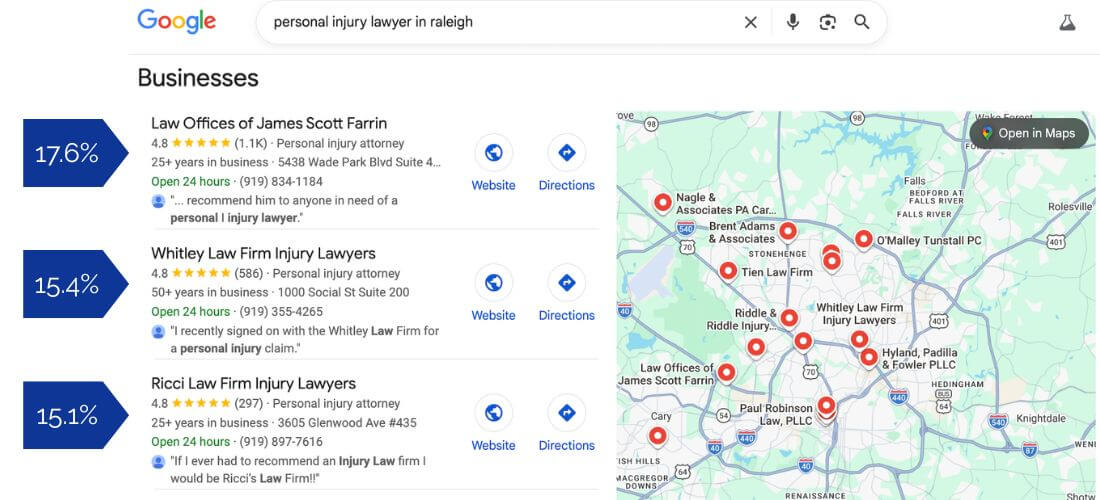
Those three spots (the map results that appear above everything else in local searches) are heavily determined by how well your GBP is built and maintained. Law practices with comprehensively optimized Google Business Profiles generate 7x more click engagement compared to incomplete listings (Cube Creative).
Despite this, most law firms have poorly optimized Google Business Profiles that are functionally invisible to the clients actively searching for them. 41% of personal injury attorneys are missing GBP descriptions entirely (Rankings). This is a genuine competitive opportunity for any attorney willing to spend two to three hours doing this right.
What a Fully Optimized GBP Looks Like
Your primary category should be specific. Think “Personal Injury Attorney” or “Family Law Attorney,” not just “Law Firm.” Your business description should be written to both inform and convert, using the terms prospective clients actually search for in your market. Every field should be complete: hours, services, phone number, website, physical address consistent with your website and legal directories.
Photos matter more than most attorneys think. According to Google, businesses featuring quality images in their GBP receive 42% more direction requests and 35% higher website visits. Upload real photos of your office, your team, and yourself — not stock imagery. Google rewards genuine engagement signals, and real photos generate significantly more interaction than generic placeholders.
Reviews are the most important ongoing element of your GBP. 71% of consumers say they primarily read reviews on Google (BrightLocal). While you cannot get a lot of reviews overnight, you can start building a consistent review request process into your client experience right now. Ask every satisfied client. Make it easy with a direct link to your review form. Respond to every review, both positive and negative.
Finally, treat your GBP like an active channel, not a listing you set up once. Post weekly updates, add Q&A entries for the questions your clients frequently ask, and monitor it for accuracy. 86% of GBP views come from category-based searches (BirdEye), which means a consistent, active, complete profile is what gets you in front of people who are searching for what you do: right now, in your market, with intent to hire.
Time investment: 2–3 hours to build correctly, 30 minutes per week to maintain. Cost: Free.
Priority 2: Your Website’s Practice Area Pages ($500-$800)
If your GBP is where clients find you first, your website is where they decide. 39% of qualified leads for law practices originate directly from their website (Justia), and 96% of people seeking legal advice use a search engine during their research process, which means they will almost certainly visit your website before they call.
The highest-return investment on your website at this stage is not a full redesign. It is making sure your most important practice area pages are genuinely useful, clearly written, and optimized for the local searches your clients are actually running.
What Strong Practice Area Pages Need
1. A clear, specific title that matches how clients search.
“Austin Family Law Attorney” will outperform “Family Law Services” every time because it mirrors the search query. Your page title, H1 heading, and URL should all reflect how a client in your market types their need into Google.
2. Genuine depth and usefulness.
Over 90% of search traffic goes to page one results, and only 0.63% of users click to page two (Backlinko). The pages that earn page one rankings are not thin, generic pages. They are pages that genuinely answer the questions clients have about their legal situation in your specific jurisdiction. What does the process look like? What does it cost? How long does it take? What do clients need to know before their first consultation? Answer these questions specifically and at length.
3. A clear, friction-free call to action.
Every practice area page should have one primary job: getting the visitor to contact you. A phone number visible without scrolling, a simple contact form, and a clear invitation to book a consultation. Do not make visitors hunt for how to reach you.
4. Mobile optimization and fast load time.
Over 53% of users will leave a site that takes more than three seconds to load mobile pages (Google). This means when they do visit, it has to load fast and work flawlessly on mobile.
5. At this budget level, focus your energy on two to three pages maximum.
Your highest-priority practice area, the one that generates the most revenue or the one you most want to grow, plus a strong homepage that clearly communicates who you serve and where. Do those exceptionally well before spreading content across every practice area you handle.
If you need to hire a writer for these pages, expect to pay $300–$500 per page for someone with legal content experience. That is a legitimate allocation within this budget. One strong practice area page that ranks and converts is worth more than five generic ones that do not.
Budget allocation: $500–$800
Timeline to results: 3–6 months for rankings to develop; conversion improvements are immediate.
Priority 3: Client Reviews Strategy ($0-$200)
Client reviews are doing double duty: they influence your Google Business Profile rankings, and they are the trust signal that converts website visitors and GBP viewers into people who actually pick up the phone.
97% of consumers read online reviews before engaging with local businesses (BrightLocal), and for legal services, where the stakes are high and the decision is personal, you can be sure clients are looking.
A prospective client who has found your firm through Google, visited your website, and seen 40 genuine five-star reviews is in a fundamentally different frame of mind than one who sees six reviews and a two-year gap since the last one.
How to Build Reviews
The system for building reviews does not require much budget, but it requires consistency. What that looks like in practice:
- Create a direct link to your Google review form and save it somewhere accessible.
- At the close of every matter, or at the point where a client expresses satisfaction with your work, send a brief message, email or text, with a genuine request and the direct link.
- Make it specific: tell them what to write about if it helps (“if you found our responsiveness and communication helpful, mentioning that would help other clients in similar situations”).
- Respond to every review, including negative ones. A professional, measured response to a critical review often does more for your credibility than the critical review does against it. It demonstrates that you take client experience seriously, which is exactly what prospective clients are evaluating.
For automating review requests at scale, basic reputation management software starts around $50–$150 per month and integrates with your intake or case management system. At a $2,000 total budget, this is optional. Manual outreach works fine when you are doing the right volume. Add the automation when your caseload makes manual follow-up impractical.
Budget allocation: $0–$200 (automation software if desired)
Timeline to results: Reviews build immediately with each request; ranking impact compounds over months.
Priority 4: One Piece of Genuinely Useful Content ($200–$400)
Content marketing for law firms works, but not the way most attorneys approach it. Publishing a generic blog post every week rarely moves the needle. Publishing one or two genuinely useful, well-optimized pieces per month on topics your prospective clients are actively searching for does.
At this budget level, the goal is not volume. It is one high-quality piece of content targeting a specific question your ideal client is Googling, the kind of question that signals they are already in the consideration phase and evaluating whether to hire someone.
Good examples by practice area:
- “What to Do in the First 24 Hours After a Car Accident in [State]” — PI
- “How Much Does a Divorce Cost in [City/State]?” — Family law
- “What Happens at a Criminal Arraignment in [State]?” — Criminal defense
- “Do I Need a Will If I Have No Assets?” — Estate planning
These work because they match real search intent, they are specific to your jurisdiction, and they position you as a credible resource before the client ever contacts you.
One more angle worth knowing: content that answers specific questions is your best path to appearing in Google’s AI Overviews and featured snippets, which increasingly appear above organic results. Structured content that directly answers a question, written with clarity and authority, is what gets surfaced in AI-generated responses.
This is what Generative Engine Optimization (GEO) looks like in practice for a small firm. It requires no special tools, just well-written, well-organized content on questions your clients are actually asking.
If writing is not your strength, a legal content writer who can produce a thoroughly researched, well-optimized 1,500–2,000 word piece costs $200–$400. That is a reasonable allocation when you consider that a single page ranking for a high-intent keyword can generate inquiries for years.
Budget allocation: $200–$400 per article
Timeline to results: 3–6 months for meaningful search traffic; immediate value as a trust asset you can share with prospective clients.
Priority 5: Local Services Ads ($600–$900)
Once your GBP is optimized, your core practice area pages are solid, and your intake process can handle leads professionally, Local Services Ads are your most efficient entry point into paid advertising.
LSAs appear above everything else on the search results page: above traditional Google Ads, above the local map pack, above organic results. They charge per lead rather than per click, which means you only pay when a prospective client actually contacts you. And the Google Screened badge they carry provides a meaningful trust signal that matters especially for attorneys, where clients are making high-stakes decisions about who to trust.
At a $600–$900 monthly budget, LSAs will not generate high volume in competitive markets, but they do not need to. In most small-to-mid markets, even a modest LSA budget generates 5–15 qualified leads per month, depending on practice area. At an average case value of $2,000–$5,000+, a single retained client from that spend pays for the entire channel many times over.
Before Starting LSAs
You need to pass Google’s verification process, which includes a background check and license verification. Budget 2–4 weeks for this before your ads can go live. It is worth it as the verification process is part of what makes the Google Screened badge meaningful to prospective clients.
LSAs work best when your GBP has reviews. Google uses your reviews as a quality signal in the LSA ranking algorithm, which is another reason reviews should precede paid advertising in this sequence.
Track every lead. LSAs provide a dashboard showing calls and messages from your ads. Monitor lead quality, dispute leads that are clearly unqualified, and use the data to evaluate whether the channel is performing for your specific practice area and market.
If $600–$900 feels aggressive for a first paid step, it is entirely legitimate to start your LSA campaign at $300–$400 per month to test the channel and validate lead quality before increasing spend.
Budget allocation: $600–$900
Timeline to results: Leads can begin within days of launch; allow 30–60 days to evaluate performance.
The Full $2,000 Allocation at a Glance
| Priority | Channel | Budget | Timeline |
|---|---|---|---|
| 1 | Google Business Profile optimization | $0 | Ongoing |
| 2 | Practice area page content (1–2 pages) | $500–$800 | 3–6 months organic |
| 3 | Reviews strategy + optional automation | $0–$200 | Builds immediately |
| 4 | One targeted content piece | $200–$400 | 3–6 months organic |
| 5 | Local Services Ads | $600–$900 | Days to weeks |
| Total | ~$1,300–$2,300 |
The range is intentional. If your budget is closer to $1,500, reduce the content spend and hold off on LSAs until month two or three. If you have $2,500 or more, increase your LSA budget and add a second content piece. The sequence stays the same regardless of where in the range you land.
What to Add as Your Budget Grows
Once these foundations are in place and performing, here is the natural next layer of investment, typically when your monthly budget reaches $3,000–$5,000:
More content, more consistently.
The firms that compound the fastest through organic search are publishing two to four high-quality pieces per month, not because volume is the goal, but because a broader content footprint means ranking for more of the questions your clients are asking. Each new page that ranks is a permanent lead source that costs nothing to maintain.
Google Ads for high-priority case types.
LSAs cover broad local intent. Google Ads let you get more particular, showing ads only for specific high-value search terms, only in specific zip codes, only during hours when your intake is staffed. This precision matters once you know which case types are most profitable for your firm.
Email marketing to your existing network.
A monthly newsletter to past clients, referral sources, and COIs is one of the lowest-cost, highest-retention activities available. It keeps your name present for the attorney who sent you a referral two years ago and is about to encounter another client who needs you. It costs almost nothing beyond the time to write it and a basic email platform at $20–$50 per month.
Referral system development.
If you are not actively cultivating referrals from COIs and peer attorneys, you are leaving your most valuable lead source underdeveloped. This deserves its own strategic attention as your marketing matures.
The Biggest Mistake to Avoid
The most common way attorneys waste a limited marketing budget is by spreading it too thin. Running a $200 Google Ads campaign alongside a $150 social media boost alongside a $100 directory listing, none of which has enough fuel to produce meaningful results.
A $200 Google Ads campaign in the legal vertical is not a campaign. It is a test that generates too few clicks to optimize and too few leads to evaluate. A $150 social media boost reaches people who are not searching for legal help at the moment they see it, with no clear path to conversion.
Concentration beats distribution at this budget level. Doing two or three things with genuine investment will almost always outperform doing eight things with token investment. The allocation above is designed around this principle: fewer channels, more depth, in the order that builds each subsequent step.
Frequently Asked Questions
The Bottom Line
Two thousand dollars a month is not a large marketing budget for a law firm. But it is enough to build a real foundation, one that compounds over time rather than resetting every time you pause a campaign.
The firms that grow from this starting point are not the ones that spend the most. They are the ones that spend in the right order, on the right foundations, and stay consistent long enough for the flywheel to start spinning. Free and optimized comes first. Owned assets come next. Paid amplification comes last… once there is something worth amplifying.
Start where the leverage is highest. Build what you own before you rent what you cannot keep. And measure what actually matters: not clicks or impressions, but consultations booked and clients retained.
For the full strategic picture behind this allocation, the rest of this series covers every dimension in depth:
- Organic vs. Paid Marketing for Law Firms: How to Know Where to Put Your Money: The framework for understanding how every channel fits into a growth system.
- How Much Should a Law Firm Spend on Marketing?: Benchmarks by firm size and practice area to build a budget around real numbers.
- Should Your Law Firm Run Ads or Invest in SEO?: A decision framework for the biggest channel question most attorneys face.
Make Your Investment Count
If you are working with a limited budget and want to make sure every dollar has a purpose, our Marketing Membership is built exactly for this stage. It helps small firms grow strategically with monthly roadmaps, clear priorities, and accountability with access to live sessions with our marketing experts… all without the cost of a full-service agency.
Or if you are ready for a dedicated partner to build and manage the full system, learn how our Fractional CMO model works.


